
Cell and gene therapies (CGTs) are transformative modalities in personalized medicine. These groundbreaking advancements address unmet needs for life-threatening or debilitating conditions that have limited or no curative options. But manufacturers often find it challenging to commercialize CGTs successfully, with one major set of challenges involving patient access.
Factors affecting access include patients’ lack of awareness or hesitancy to pursue specific therapies. A complex coordination process and financial impact, both on patients and providers, can also negatively impact patient access. For your commercialization strategy to succeed, these challenges can be addressed through strategies such as:
- Increasing awareness of the patient support services you’re providing to ensure these services are utilized
- Coordinating the various services and stakeholders involved from enrollment through drug administration so patients continue to progress through their treatment journey
- Addressing patient proximity hurdles so patients can get to their treatment sites
- Working with various sites of care using alternative and flexible models
The following recommendations are intended to help you navigate these challenges so you can deliver on your CGT’s potential to improve patient lives.
Increasing awareness and utilization of patient services
Challenge:
For CGTs that treat rare conditions, providers play a vital role in educating patients on available options. Providers, however, may not be aware of the variety of services that may be available, such as travel expense assistance, copay assistance programs, scheduling coordination, and after-therapy follow-up communication.
Even if providers are aware of these services, utilization may be low. If multiple third-party service providers are involved, the enrollment process can be challenging as each may have different eligibility requirements and processes.
Where providers have undertaken a patient service-like reimbursement support themselves – even when you’ve made claims and appeals assistance available to them – they may face unexpected challenges unique to the high upfront cost of CGTs. In the event of claims denials, navigating the appeals process will place additional administrative burden on both the site of care and the providers. This will cause delays in treatment. 94 percent of health care professions report delays in patient care from prior-authorization-related processes, with 24 percent reporting that a prior authorization led to a serious adverse event for a patient in their care1. These delays can place the patient’s life in danger and present a moral dilemma to the provider.
Recommendation:
Focus your education efforts on providers and their staff to ensure they understand the available services, the corresponding processes, and can communicate this information effectively to their patients. A field reimbursement team can help. This team’s primary responsibility is to educate providers about available coverage. Since they already have relationships with providers’ offices, they are in an ideal position to also increase awareness about patient services.
Incorporate general education on available patient services into treatment site onboarding provided by field reimbursement teams. When patients are referred for treatment at a qualified treatment center, the field teams can communicate further with the site directly and offer more specific information about patient support services to available to patients, potentially increasing service utilization.
Engage patient advocacy groups who can help boost awareness. These stakeholders are highly knowledgeable about the specific diseases and are tightly integrated into the community of patients and caregivers. They are an invaluable resource for learning about patient struggles with the current standard of care, the benefits and drawbacks of available treatment options, and any barriers to receiving a new therapy. Build relationships with these groups to share patient outreach ideas and receive informed feedback on patient engagement strategies to improve awareness and access.
For providers who are submitting insurance claims on their own and who have become overwhelmed by an increasingly complicated appeals process, partner with a patient services provider who has been successful in working with a wide range of payers and is willing to support retroactive claim submission. A field team can raise the providers’ awareness of reimbursement support that is experienced in payers’ processes that may be able to help patients with an existing denied claim.
Maintaining visibility throughout the patient journey
Challenge:
CGT treatment is a complex web of components that include ordering, scheduling, logistics, shipping, transitions of care, and patient support tasks. There is a high risk of a breakdown in communication or execution anywhere across these activities, preventing patients from accessing treatment. You need to know how each patient’s journey is progressing so you can proactively respond to any potential barriers and facilitate successful administration of therapy, all while providing a consistent experience for patients and providers.
Recommendation:
Strive to support most of your patients through a patient services program. You can encourage utilization by building a program providers believe will support their patients.
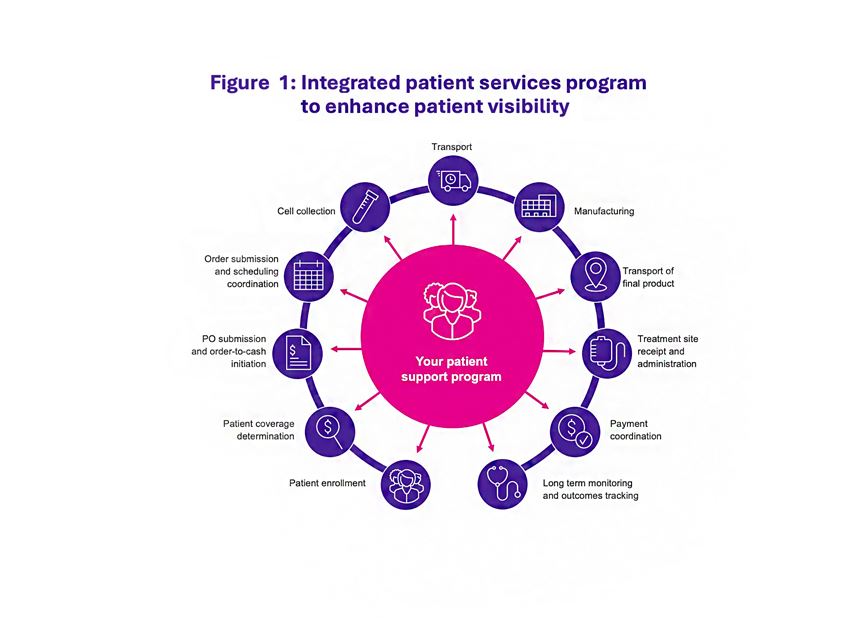
Leveraging a patient services program for all enrollments allows for synchronization of data across the various services involved and will provide you with a comprehensive view into each patient’s treatment journey. As a result, true end-to-end visibility is enabled as coverage determination, order management, treatment scheduling, and logistical details are captured for viewing (Figure 1). With this orchestration and visibility, you can help patients and caregivers navigate the various services available to them to proactively address anticipated delays with minimal impact to patient treatment administration.
Additionally, you can use insights from a comprehensive view of the patient and product journey to inform future decisions about your CGT program, which can be lost in a fragmented patient support approach.
Coordinating stakeholders across the patient journey
Challenge:
Added to the challenge of coordinating a patient’s CGT treatment journey is the need to transfer ownership of each step among the various stakeholders, such as the manufacturer, provider, pharmacy, and patient support program. Each stakeholder also requires specific visibility into the patient’s progress along the journey. You need an effective process that facilitates handoffs at the appropriate stage and avoids gaps in communication and coordination.
Recommendation:
Develop a plan that prioritizes integrated visibility and reportability for stakeholders. For example, configure your patient management platform with pre-defined integration pathways between necessary stakeholders to enable greater monitoring of the patient and treatment journey. This integration allows providers, patients, and caregivers to go through the eligibility steps to utilize the services critical to patient access, as well as to know who owns what task at each step. Connectivity between the patient support program and the patient’s care team can also help reduce missteps during service delivery and treatment administration. Creating an integrated implementation plan that involves all key stakeholders will bridge gaps to facilitate a coordinated and streamlined patient journey.
Getting patients to treatment locations
Challenge:
Patient proximity to sites of care is an important consideration to a patient access strategy for CGT, but the inherent complexity of the therapeutic modality limits the number of sites able to provide it. Consequently, patients may struggle to get to a faraway treatment center as well as access resources for post-treatment monitoring. Additionally, receiving treatment at a distant facility may require the patient stay in close proximity to the site for as long as four to six weeks for safety and monitoring requirements, which can be an additional logistical and financial complication for patients and their caregivers.
Recommendation:
Expand your network of treatment centers strategically to make your treatment accessible as possible. Field times can provide onboarding support through education and training on the product as well as reimbursement strategy.
Offer travel expense assistance support to help improve access to patients that still need to travel long distances. These assistance programs should be strategic about requirements such as qualification criteria and process to maximize impact. Understanding your patient population can inform the eligibility parameters. For instance, if the majority of your population is pediatric, your program should include additional assistance to one or even two caregivers traveling with young patients. Conduct exposure analysis to understand how many potential patients and caregivers will need travel expense assistance and other types of support.
Use a case management approach with your patient support program so that patients receive assistance through their entire treatment journey, from enrollment, to benefit verification and claims support, through treatment, and their transition to outpatient care. This model is effective by assigning each patient to an individual support team member who assists with continuity of care throughout that patient’s entire treatment journey.
Working with various sites of care to provide patient access
Challenge:
The type of healthcare delivery model will determine the sites of care where patients can access a therapy — whether inpatient, outpatient, surgical, community, or infusion center. Some sites of care may only be able to acquire CGTs through a traditional buy-and-bill model, but may not be able or willing to take on the financial risk of this model because of the high upfront cost.
Recommendation:
Determine the types of care facility where your therapy will be administered. Profile the providers and stakeholders at these sites of care to learn more about their business operations and preferences. Develop a plan that works with their processes and preferences.
For example, if you anticipate hurdles for a site of care with the buy-and-bill model, you can consider engaging a distribution partner who has relationships with specialty pharmacies. Specialty pharmacies take on the responsibility of purchasing and dispensing medications. You may also consider a just-in-time inventory management approach to reduce the amount of capital tied up in inventory and shorten the duration the site must maintain proper storage of CGTs.
REFERENCES:
- American Medical Association. 2023 AMA Prior Authorization Physician Survey. 2024. Accessed 18 February 2025. Available online at: https://www.ama-assn.org/system/files/prior-authorization-survey.pdf
Disclaimer: This article may contain marketing statements and shall not constitute legal advice. Cencora, Inc. strongly encourages readers to review the references provided with this article and all available information related to the topics mentioned herein and to rely on their own experience and expertise in making decisions related thereto.

Cencora.com is providing automated translations to assist in reading the website in languages other than English. For these translations, reasonable efforts have been made to provide an accurate translation, however, no automated translation is perfect nor is it intended to replace human translators. These translations are provided as a service to users of Cencora.com and are provided "as is." No warranty of any kind, either expressed or implied, is made as to the accuracy, reliability, or correctness of any of these translations made from English into any other language. Some content (such as images, videos, Flash, etc.) may not be accurately translated due to the limitations of the translation software.
Any discrepancies or differences created in translating this content from English into another language are not binding and have no legal effect for compliance, enforcement, or any other purpose. If any errors are identified, please contact us. If any questions arise related to the accuracy of the information contained in these translations, please refer to the English version of the page.