
Six years after the first approved gene therapy in ophthalmology, the field is seeing a flurry of activity in innovative cell and gene therapy (CGT) studies addressing high unmet needs. Here’s what could be in store for the future.
Opportunities ahead
The challenge now is to further develop the field with additional CGTs to address a range of diseases with burdensome or ineffective treatment options. Some of these diseases are extremely rare — an estimated 0.1% of people over 40 develop macular telangiectasia type 21, for example —while others, like age-related macular degeneration, are very common2. With their curative intent and some with regenerative potential, such therapies could be strong candidates for these indications.
The growth of novel CGTs in development for indications in ophthalmology may also be explained due to the eye’s physiology. Therapies may be administered locally and in small volumes since the organ is relatively compartmentalized. By using targeted delivery of gene therapy vectors, strong inflammatory responses may be avoided by targeting regions of the eye that have immune privilege.
Current clinical studies
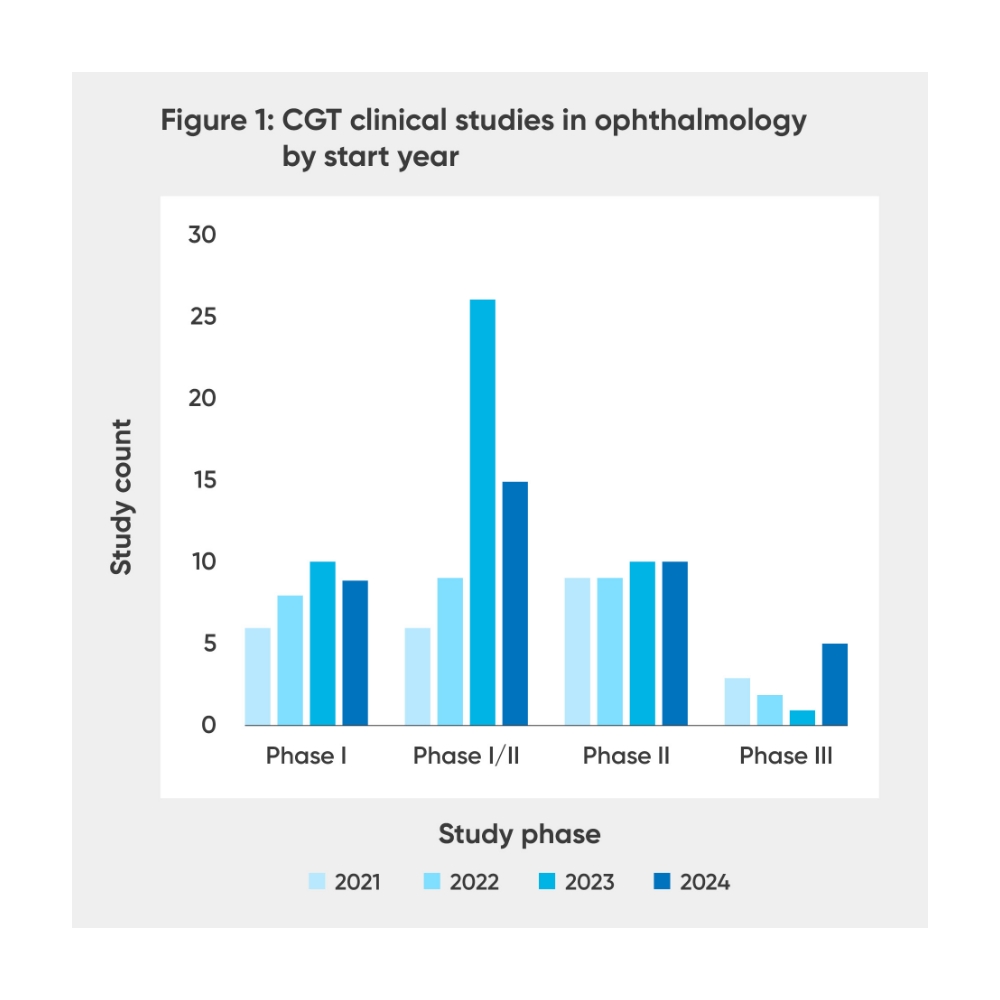
While there have been a moderate and static number of new phase I and/or II CGT clinical studies in ophthalmology over the past three to four years, there was a marked increase in such studies in 2023 — a possible sign of recent progress (Figure 1).
Key takeaways from these current studies include:
- Pathway possibilities: A phase II study component can produce BLA-enabling data under the accelerated approval pathway, which allows for surrogate or intermediate endpoints. It’s likely that some drug sponsors will take this approach as they pursue novel therapies for rare eye diseases.
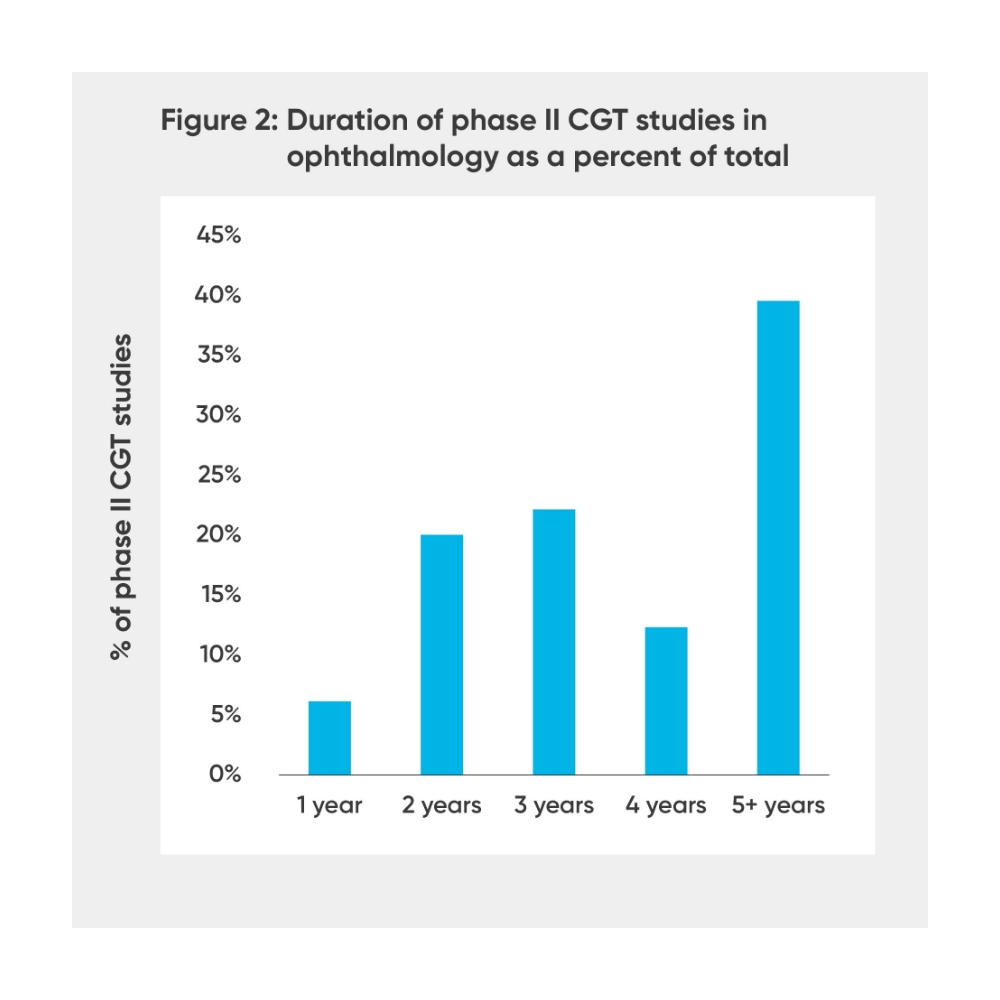
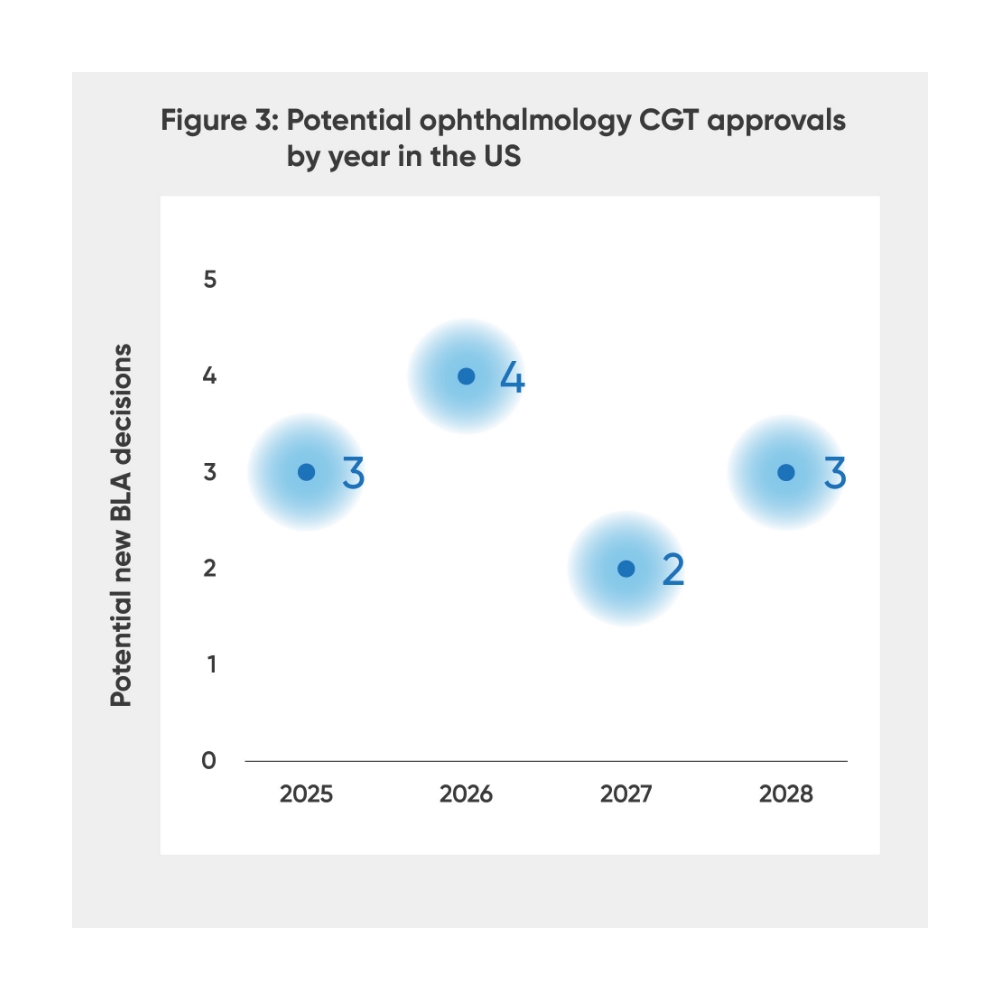
- Regulatory filings incoming: Analysis of study length for CGTs in ophthalmology revealed that about half of phase II studies in ophthalmology have a duration of three years of less (Figure 2). If these studies produce BLA-enabling data within that timeframe, we may expect to soon see regulatory filings for drugs that achieve their primary or surrogate endpoints. Furthermore, an analysis of ophthalmology CGT candidates with the potential to finish collecting BLA-supporting evidence in the near-term suggests that the industry is poised to see a spike of activity in this space (Figure 3).
A diverse and innovative landscape
For many years there has been a heavy focus on biologicals and traditional pharmaceuticals for disease management in ophthalmology. These drugs tend to treat symptoms, may only delay degenerative processes, and often require repeat injections, or are part of a maintenance therapeutic program. For some indications, like many forms of retinitis pigmentosa (RP), there are currently no approved interventional treatments.
CGTs often aim to address the underlying cause of disease and many have curative intent. For rare genetic disease, like RP, gene-replacement therapy can address the mechanism behind this progressive and debilitating disease. Because RP can be caused by a single mutation in one of any of several dozen genes, some CGT manufacturers are developing gene-agnostic approaches to boost patient access. Developers are also using different therapeutic agents (gene-replacement therapy, modifier gene therapy, therapeutic proteins secreted by cellular implants), as well as different routes of administration (subretinal, suprachoroidal, intravitreal) to optimize delivery of drug candidates and improve clinical response.
This diversity in approaches and the potential for curative outcomes make CGTs an exciting and promising therapeutic modality in the ophthalmology space, as they offer hope for patients with difficult to treat – or previously untreatable – conditions.
Disclaimer: This article may contain marketing statements and shall not constitute legal advice. Cencora, Inc. strongly encourages readers to review the references provided with this article and all available information related to the topics mentioned herein and to rely on their own experience and expertise in making decisions related thereto.
REFERENCES:
- Charbel, Issa P, et al. Macular telangiectasia type 2. Progress in Retinal and Eye Research. May 2013. Accessed 7 February 2025. Available online at: https://pubmed.ncbi.nlm.nih.gov/23219692/
- Prevent Blindness. News Release: New study finds higher AMD prevalence & high county variation. 3 November 2022. Accessed 7 February 2025. Available online at: https://preventblindness.org/new-study-amd-prevalence-2019/

Cencora.com stellt automatisierte Übersetzungen zur Verfügung, um das Lesen der Website in anderen Sprachen als Englisch zu erleichtern. Für diese Übersetzungen wurden angemessene Anstrengungen unternommen, um eine genaue Übersetzung zu liefern, jedoch ist keine automatisierte Übersetzung perfekt und auch nicht dazu gedacht, menschliche Übersetzer zu ersetzen. Diese Übersetzungen werden den Nutzern von Cencora.com als Service zur Verfügung gestellt und "wie besehen" zur Verfügung gestellt. Es wird keinerlei Garantie, weder ausdrücklich noch stillschweigend, für die Genauigkeit, Zuverlässigkeit oder Richtigkeit dieser Übersetzungen aus dem Englischen in eine andere Sprache übernommen. Einige Inhalte (z. B. Bilder, Videos, Flash usw.) können aufgrund der Einschränkungen der Übersetzungssoftware möglicherweise nicht genau übersetzt werden.
Jegliche Unstimmigkeiten oder Unterschiede, die bei der Übersetzung dieser Inhalte aus dem Englischen in eine andere Sprache entstehen, sind nicht bindend und haben keine rechtliche Wirkung für die Einhaltung, Durchsetzung oder andere Zwecke. Wenn Fehler festgestellt werden, kontaktieren Sie unsbitte . Wenn Sie Fragen zur Richtigkeit der in diesen Übersetzungen enthaltenen Informationen haben, lesen Sie bitte die englische Version der Seite.